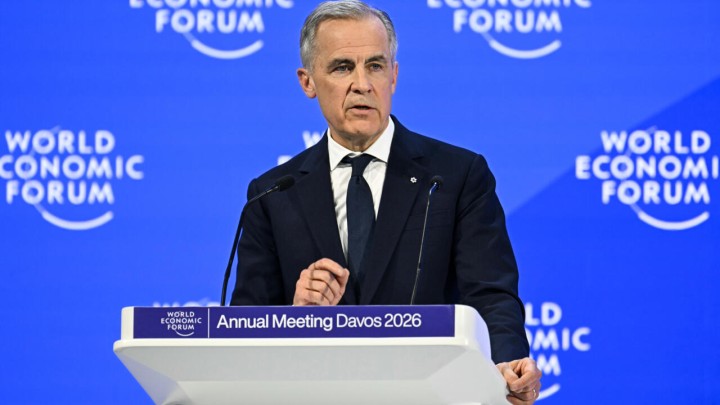
Davos,
Switzerland
At the 2026
World Economic Forum (WEF) in Davos today, Canadian Prime
Minister Mark
Carney delivered a striking and widely reported speech warning
that the traditional rules-based international order is unraveling amid rising great-power rivalry and
strategic competition. Carney’s remarks, delivered ahead of a major address by
U.S. President Donald Trump, underscored a growing concern among middle powers
about a shifting global landscape and the need for new forms of cooperation.
“We Are in the Midst of a Rupture, Not a
Transition”
In a speech to political, business and diplomatic
leaders, Carney said the post-World War II international framework, long
anchored by U.S.
leadership and a system of multilateral institutions is no
longer functioning as it once did. He described this period as a “rupture” rather than a
temporary transition,
arguing that the mechanisms that once kept peace and stability are now under
severe strain.
Carney explained that the old order, while imperfect,
provided valuable public goods such as open sea lanes, predictable
international finance, collective security arrangements and dispute-resolution
frameworks. “American hegemony in particular helped provide public goods,” he
said, noting that countries around the world benefited from that structure.
However, he asserted, that bargain “no longer works.”
According to Carney, recent crises in finance, health, energy and geopolitics have
laid bare weaknesses in deep global integration. He noted that economic integration
itself is being used as a tool of coercion, with tariffs,
supply chains and financial infrastructure deployed by great powers as
instruments of influence rather than instruments of shared growth.
Pressure on Middle Powers
The Canadian prime minister did not mention President
Trump by name, but his remarks were widely interpreted as a response to rising
unilateral actions by major powers including recent U.S. proposals regarding
Greenland and tariff threats against European allies that many see as testing
international norms.
Carney warned that smaller and “middle” powers such as
Canada must rethink how they protect their interests in a world where they can
no longer rely solely on old alliances or expect that compliance with global
norms will guarantee security. “If you are not at the table, you are on the
menu,” Carney said, urging middle powers to work together and build flexible,
values-based coalitions that can uphold mutual interests in trade,
security, and development.
Critique of the Rules-Based System
One of the most striking aspects of Carney’s speech
was his critique of the so-called “rules-based international order” a concept
that has underpinned global diplomacy for decades. He described the order as a “pleasant fiction” that helped foster cooperation, but he
argued that its credibility has been eroded as powerful nations increasingly
act unilaterally.
“Great powers have begun using economic integration as
weapons, financial infrastructure as coercion, supply chains as vulnerabilities
to be exploited,” he said. “You cannot live within the lie of mutual benefit
through integration when integration becomes the source of your subordination.”
Call for Strategic Autonomy and Collective Action
Rather than advocating a return to the old system,
Carney urged nations to build a new kind of global cooperation based on strategic autonomy, shared
values and flexible alliances. He stressed that middle powers have strengths such
as diversified economies, advanced human capital, and robust institutions that
they can leverage to form new partnerships capable of navigating a fragmented
global environment.
His speech called for a pragmatic approach where
nations do not idolize the past but instead work together on concrete issues
with partners who share common interests and principles. “We should not mourn
it,” he said of the old order. “Nostalgia is not a strategy.”
Global Reaction and Context
Carney’s remarks come against a backdrop of intense
debate at Davos, where leaders have been discussing rising geopolitical
tensions, economic challenges and the future of global cooperation. They were
also issued just as President Trump is set to deliver his own address to the
forum an event likely to attract global attention amid controversy over U.S.
foreign policy, including its stance on Greenland and trade disputes.
European leaders have broadly echoed concerns about
the erosion of established norms, with French President Emmanuel Macron and
others emphasising the need for unity and respect for sovereignty in response
to revelations of tariff threats and diplomatic pressure.
Carney’s speech is likely to be one of the most
discussed at Davos this year, signaling a potential pivot point in global diplomacy as nations reassess how to cooperate
in a world where traditional frameworks are under unprecedented stress.