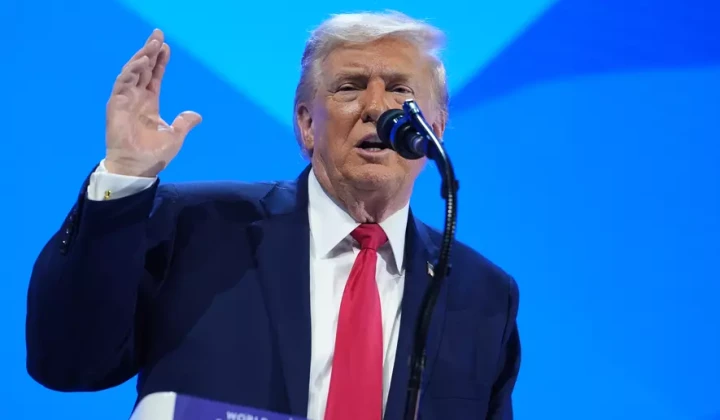
Davos, Switzerland
In a high-profile address at the World
Economic Forum (WEF) on Wednesday, U.S. President Donald Trump ruled out the use of military force to take
control of Greenland, a move that had alarmed European allies and
threatened to strain transatlantic ties. However, Trump reiterated his desire
to pursue negotiations over the Arctic
territory’s future, maintaining pressure on NATO partners while
softening the tone of recent controversial rhetoric.
Speaking before global political and
business leaders gathered at the annual conference in Davos, Trump said that
while the United States once had strategic roles in Greenland, he does not intend to invade or use military
strength to seize the island. “We probably won’t get anything unless I
decide to use excessive strength and force and we would be, frankly,
unstoppable. But I won’t do that,” Trump said, adding “I don’t have to use force. I don’t want to use force. I won’t use
force.”
Despite the declaration, Trump
continued to assert that the U.S. remains uniquely positioned to secure
Greenland which is a vast Arctic territory that is formally part of the Kingdom of Denmark and has its own autonomous
government. He argued that Greenland’s strategic location, rich in
minerals and military importance, is critical not just for U.S. interests but
for collective Western security.
From
Tariffs and Tension to Negotiations Framework
The speech came on the heels of
weeks of tense exchanges between Washington and European capitals. Just days
earlier, Trump had hinted at tariffs on
European allies if they did not comport with U.S. demands on Greenland, a
plan that raised fears of economic retaliation and schisms within NATO. But at
Davos, Trump appeared to scale back
those threats.
He announced that a preliminary “framework” agreement had been
reached with NATO that could open a path for constructive dialogue over
Arctic cooperation, though details remain vague and have not been publicly
disclosed. The compromise prompted European officials to pause controversial
retaliatory plans and expressed cautious optimism about avoiding a full trade
and diplomatic rupture.
European
Reaction and Concerns
Leaders from Denmark and other
European nations reacted with relief
but continued caution. Denmark’s foreign minister welcomed the
acknowledgment that military action is off the table but stressed that the
fundamental ambition to pursue U.S. interests in Greenland remains a political
challenge, not a resolved issue. European officials have repeatedly asserted
that Greenland is not for sale
and that any change in status must involve the island’s residents, who enjoy
broad autonomy and self-rule.
NATO Secretary-General Mark Rutte later clarified that
discussions with Trump did not directly address Greenland’s sovereignty,
framing the talks instead around Arctic
security cooperation particularly given concerns about increasing
Russian and Chinese activity in the region.
Trump’s
Broader Davos Message
Trump’s Greenland remarks were part
of a broader address that touched on U.S. foreign policy priorities, NATO
burden-sharing, and economic growth. He used the platform to characterise the
U.S. as a “great power” with unmatched military capability and to critique
parts of Europe’s policy direction. Some of his comments referenced World War
II alliances and implied that Western partners have under-leveraged U.S.
defence commitments.
The president’s position elicited
mixed reactions from world leaders and analysts. Some European diplomats
welcomed the clarification on force, while others criticised the underlying
message as an attempt to apply leverage
over sovereign nations. Observers say such rhetoric could still
undermine trust within NATO, even if outright military threats are off the
table.
Market
and Global Impacts
Financial markets reacted to Trump’s
remarks. Following initial volatility from earlier geopolitical concerns, major
U.S. stock indices saw modest gains as investors took reassurance from his
commitment to avoid military escalation. Market analysts described the shift as
a welcome de-escalation in risk
sentiment for global equities.
What
Comes Next?
Trump’s call for immediate
negotiations signals that the Greenland
question will remain part of international discourse. Future talks are
expected to involve the U.S., Denmark, Greenland’s government, and NATO
representatives. The aim from the U.S. perspective is to balance strategic
access and defence cooperation with respect for sovereignty and alliance unity.
Meanwhile, European capitals and
analysts are closely watching how these discussions evolve, particularly in the
context of broader security issues such as Arctic geopolitics, NATO cohesion,
and competition with other global powers in the High North.